
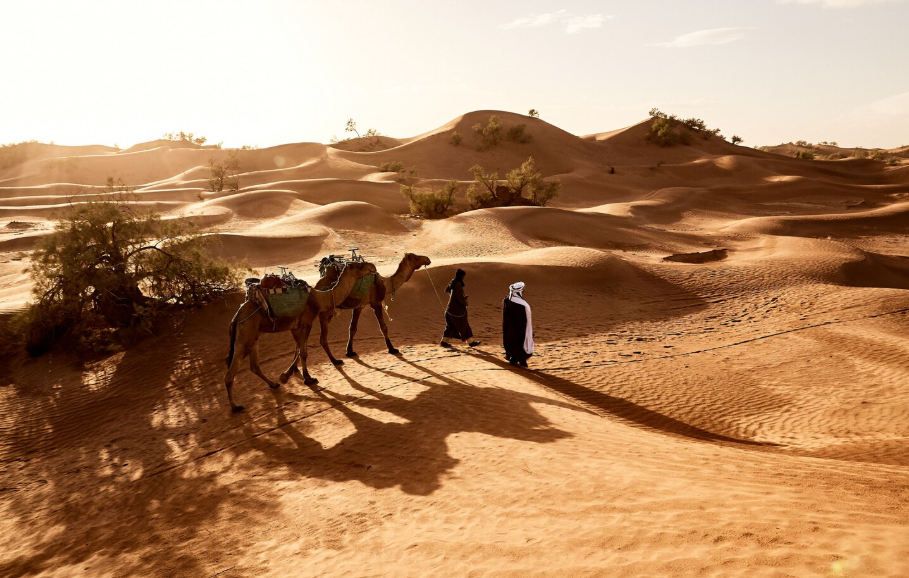
The Sahara is the image most people have in mind when they think of Morocco. Endless dunes, a line of camels silhouetted against an orange sky, and a sky so clear you can see the Milky Way without trying. In 2026, Sahara Desert Morocco tours are better organized, more sustainable, and more comfortable than ever. But the core experience hasn’t changed. It’s still about silence, scale, and spending a night under a sky you can’t see from any city.
Where to Go: Merzouga vs. Zagora
Morocco’s Sahara isn’t one place. For tours, you’ll choose between two gateways.
Merzouga and Erg Chebbi is the classic choice. Located 8 hours from Fes and 6 hours from Marrakech, it’s home to Erg Chebbi, a 150-meter-high dune system that glows red at sunset. This is where most 3-day Sahara tours go. The dunes are dramatic, the camps are well-established, and the camel treks feel like the real Sahara.
Zagora and Erg Chigaga sits 6 hours from Marrakech. The dunes are smaller and the landscape is more rocky than sandy, but the advantage is time. If you only have 2 nights for a Sahara trip, Zagora makes it feasible. It’s also less crowded than Merzouga.
For first-timers with 8+ days in Morocco, choose Merzouga. For shorter trips, Zagora works.
The Camel Trek: What It’s Actually Like
Camel trekking is the centerpiece of Sahara Desert Morocco tours. Don’t expect Lawrence of Arabia for 3 days. Most treks are 45 minutes to 2 hours each way.
You’ll meet your camel and guide at the edge of the dunes about an hour before sunset. The guides handle the animals, and you’ll ride single file into the camp. It’s slow, bumpy, and surprisingly meditative. Walking alongside is also an option if riding isn’t for you.
The guides are Berber, and many have been doing this for 20+ years. They’ll stop for photos, explain how to mount and dismount, and make sure you’re comfortable. Tipping 20-50 dirhams per person is standard.
In 2026, animal welfare standards have improved. Reputable camps limit load weight, provide water breaks, and rotate camels to avoid overwork. Ask your tour operator how they vet camps if this matters to you.
The Camps: From Basic to Luxury
Camps in the Sahara have evolved. Gone are the days when “desert camp” meant a sleeping bag on the sand with no toilet. Now you have three tiers:
Standard Camps: Shared bathroom blocks, canvas tents with beds and blankets, communal dining tents. Dinner is tagine cooked over a fire, followed by drumming and singing. Cost is usually included in budget tours. Expect basic but clean facilities.
Luxury Camps: Private en-suite tents with real beds, hot showers, and flush toilets. Interiors use Berber rugs, low seating, and lantern lighting. Some have plunge pools and private dining under the stars. These are included in mid-range and luxury Morocco tours.
Eco Camps: A growing category in 2026. Solar-powered, limited water use, and run by local Berber families. Fewer amenities, but a lower environmental impact and more direct income to local communities.
All camps serve dinner and breakfast. Dinner is usually tagine, couscous, bread, and mint tea. Vegetarian and vegan options are available if you tell the operator ahead of time.
Stargazing in the Sahara
Light pollution in the Sahara is close to zero. On a clear night, you’ll see thousands of stars, the Milky Way as a distinct band, and planets without a telescope.
Most camps include a stargazing session after dinner. Guides point out Orion, the North Star, and tell traditional Berber star stories. Some luxury camps now offer telescopes and astrophotography guides for an extra fee.
The best months for stargazing are October to April. Summer nights are clear too, but the heat makes sleeping outside less comfortable. Avoid full moon periods if you want the darkest sky.
What a Typical 3-Day Sahara Tour Looks Like
Most Sahara Desert Morocco tours follow this pattern from Marrakech:
Day 1: Depart Marrakech early, cross the High Atlas via Tizi n’Tichka pass, stop at Aït Benhaddou, and overnight in Ouarzazate or Dades Valley.
Day 2: Drive through Todra Gorge to Merzouga. Camel trek to camp at sunset. Dinner, drumming, sleep in a tent.
Day 3: Sunrise on the dunes, camel back to Merzouga, then return drive to Marrakech or onward to Fes.
From Fes, it’s a 2-day version: Fes → Merzouga with an overnight camp, then return to Fes.
Costs for 2026
Sahara tours are usually sold as part of a longer Morocco itinerary, but standalone prices look like this:
– Budget 2-day/1-night from Marrakech: $120-$180. Includes transport, camel trek, basic camp, dinner, breakfast.
– Mid-range 3-day/2-night from Marrakech: $280-$400. Private transport, 4-star hotels en route, luxury desert camp.
– Luxury 3-day/2-night: $600-$900. Private 4×4, 5-star riads, premium camp with private dining.
Costs are per person for shared tours, per group for private tours. Always confirm what’s included. Some cheap tours add a “desert supplement” of $40-$60 on the road.
What to Pack for the Desert
You don’t need specialized gear, but a few items make a difference:
– Layers: Days are hot, nights are cold. A fleece or light jacket is essential year-round.
– Scarf or shemagh: For sun, wind, and sand. You can buy one in Marrakech for $5.
– Headlamp: Camps have lanterns, but a headlamp is useful for walking to bathrooms at night.
– Sunglasses and sunscreen: The sun is intense, even in winter.
– Wet wipes and hand sanitizer: Facilities are basic in standard camps.
Leave large suitcases in your Marrakech or Fes hotel. Camps have limited space, and you only need an overnight bag.
Responsible Tourism in the Desert
The Sahara is fragile. Sand dunes erode, and water is scarce. In 2026, look for operators who:
– Use established camps that manage waste properly.
– Limit group sizes to avoid overcrowding camps.
– Pay fair wages to Berber guides and drivers.
– Avoid single-use plastics.
Ask your operator where their camp is located and who runs it. Camps owned and staffed by local families keep more money in the community.
Is a Sahara Tour Worth It?
If you only have 7 days in Morocco, a 2-night Sahara extension is worth it. The drive is long, but the contrast between Marrakech’s chaos and the desert’s silence is what makes the trip memorable.
Skip it if you hate long drives, have mobility issues that make camel riding difficult, or are traveling in July-August when desert temperatures exceed 45°C. In those cases, focus on the Atlas Mountains and northern cities instead.
Final Tip
Don’t treat the Sahara as a checkbox. Build in time to sit still. The value of the Sahara Desert Morocco trip isn’t the camel ride or the camp dinner. It’s sitting on a dune after everyone else has gone to bed, listening to nothing, and realizing how small you are under that sky.